Tempe Town Lake crown jewel of Rio Salado project
Destination Arizona
B. Thomas Cooper
Editor
Live in an arid climate long enough, and one soon begins to dream of water. In Tempe, Arizona, that dream has come true, in the form of a 99 million gallon, man made lake.
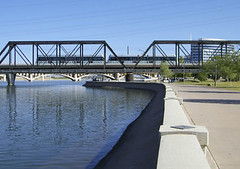
Tempe Town Lake
In 1911, workers completed construction of the massive Roosevelt Dam east of the fledgling city of Phoenix, Arizona. Save for the occasional flood, water would soon cease to flow through the Salt River toward the growing community downstream. The river water was redirected through an intricate canal system to accommodate farmland in the valley. What had formerly been a rich riparian habitat along the river, quickly became a barren wasteland.
Faced with starvation, wildlife indigenous to the river basin was forced to abandon the dieing habitat. By the mid fifties, the riverbed had succumbed to neglect. The dry river became home to a bevy of industry, land fills and quarries. The once glorious Salt River had reached rock bottom.
Then in 1966, a wonderful thing happened. Dean Elmore of the College of Architecture at Arizona State University came up with a wonderful, wonderful idea. Elmore and his students envisioned building a series of locks and channels along the dry riverbed. They proposed refilling the channels with water, building sections of park and greenbelt along the rivers neglected banks and rehabilitating the surrounding ecosystem. It was a grand and beautiful plan.
In 1987, after years of research and development, the Rio Salado project was finally put before valley voters. The surrounding valley communities resoundingly defeated the bill, but in Tempe, residents remained supportive. Tempe Mayor Harry Mitchell agreed, announcing the town of Tempe was prepared to go it alone. It was the beginning of what would slowly develop into Tempe Town Lake.
Eight rubber bladder dams, each 16 feet tall and 240 feet in length, were installed along the river, creating a 2-mile long lake with over 220-surface acres of water. Finally, on
June 2, 1999, Water from the Central Arizona canal began flowing into the Tempe Town Lake. 43 days later, the lake was officially declared full.
Ten years later, Tempe Town Lake has become the top attraction in the valley, with nearly three million people visiting the lake annually. It is the crowning achievement of a project over thirty years in the making.
Each year, millions of people enjoy the lake. Some boat, while others choose to walk or jog along the miles of adjoining trails. Valley parents bring their family for an afternoon picnic. Some simply come to the lake to gaze at this beautiful oasis in the middle of the bustling city.
The Rio Salado project may never be entirely completed, and perhaps that’s a good thing. Valley residents can expect the lake and the surrounding rehabilitated ecosystem to continually grow and improve with age. Downstream, mighty cottonwood trees once again adorn the riverbed and the indigenous wildlife, absent for nearly a hundred years, is slowly returning.
On Dec. 12, 2009, the town of Tempe will celebrate the tenth birthday of this extraordinary environmental achievement. The free birthday bash begins at 3 p.m., and will feature fireworks and a Festival of Lights Boat Parade, sponsored by Arizona Public Service.
Destination Arizona
Destination Arizona
Labels: aps, Arizona History, arizona public service, B. Thomas Cooper, canals, destination arizona, destinationarizona, phoenix history, rio salado, roosevelt dam, tempe town lake
posted by B. Thomas Cooper @ 3:23 PM
0 comments


![[Valid Atom 1.0]](http://feedvalidator.org/images/valid-atom.png "Validate my Atom 1.0 feed")
 Subscribe to